Model 2 - Hand Landmark Detection
Overview
Once a hand is located by Model 1, the Hand Landmark Detection model is used to find its detailed structure. This is the most computationally intensive model in the pipeline, responsible for predicting the precise 3D coordinates of 21 key hand landmarks from a cropped image of a single hand.
Model Specifications
- Model File:
hand_landmarks_detector.xml - Architecture: Custom CNN with attention mechanisms optimized for landmark detection
- Purpose: Predict precise 3D coordinates of 21 key hand landmarks from cropped hand regions
- Computational Intensity: Most resource-intensive model in the pipeline
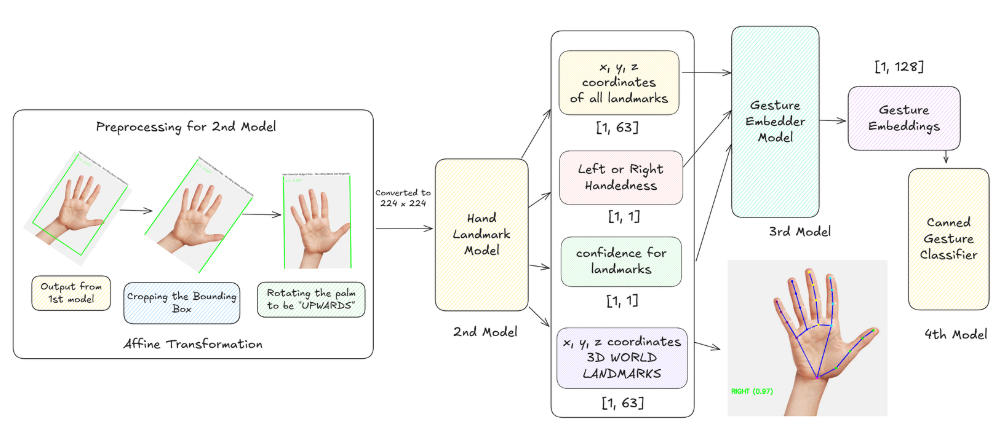 Figure: Function diagram for Model 2 processing pipeline.
Input/Output Specifications
Input Requirements
- Format:
[1, 224, 224, 3]- A cropped and warped image of a single hand - Resolution: 224x224 pixels (standardized input size)
- Source: Generated using the rect_points from Model 1 (Hand Detector)
- Preprocessing: Affine transformation and image warping from original frame
Output Format
The model produces four distinct outputs providing comprehensive hand analysis:
-
Identity:
[1, 63]- The 21 landmarks as pixel coordinates
[x, y, z]relative to the 224x224 input crop - 63 values total (21 landmarks × 3 coordinates each)
- The 21 landmarks as pixel coordinates
-
Identity_1:
[1, 1]- Confidence score indicating the presence of a hand in the crop
- Single float value representing hand presence probability
-
Identity_2:
[1, 1]- Confidence score for handedness classification (left vs. right hand)
- Single float value for left/right hand determination
-
Identity_3:
[1, 63]- World landmarks providing 3D coordinates in meters
- Real-world spatial coordinates for depth-aware applications
21-Point Hand Landmark Model
Landmark Structure
The model detects landmarks following the MediaPipe hand model specification:
Wrist (1 point)
- Point 0: Wrist center - base reference point
Thumb (4 points)
- Point 1: CMC joint (base) - thumb base connection
- Point 2: MCP joint - thumb metacarpal joint
- Point 3: IP joint - thumb interphalangeal joint
- Point 4: Thumb tip - thumb fingertip
Index Finger (4 points)
- Point 5: MCP joint (base) - index finger base
- Point 6: PIP joint - proximal interphalangeal joint
- Point 7: DIP joint - distal interphalangeal joint
- Point 8: Index tip - index fingertip
Middle Finger (4 points)
- Point 9: MCP joint (base) - middle finger base
- Point 10: PIP joint - proximal interphalangeal joint
- Point 11: DIP joint - distal interphalangeal joint
- Point 12: Middle tip - middle fingertip
Ring Finger (4 points)
- Point 13: MCP joint (base) - ring finger base
- Point 14: PIP joint - proximal interphalangeal joint
- Point 15: DIP joint - distal interphalangeal joint
- Point 16: Ring tip - ring fingertip
Pinky (4 points)
- Point 17: MCP joint (base) - pinky base
- Point 18: PIP joint - proximal interphalangeal joint
- Point 19: DIP joint - distal interphalangeal joint
- Point 20: Pinky tip - pinky fingertip
Processing Pipeline
The Hand Landmark Detection model operates through a sophisticated pipeline that transforms detected hand regions into detailed landmark coordinates:
- Region Rectification and Cropping (Function 1): Image warping and hand region extraction
- Landmark Detection and Smoothing (Function 2): 21-point detection with temporal stabilization
Technical Implementation
Key Functions & Logic
1. Image Warping
- Function:
warp_rect_imgin hand_landmark.py - Process: Performs affine transformation on original full-resolution camera frame
- Result: "Cuts out" the hand and straightens it, creating 224x224 input
2. Model Inference
- Function:
_process_landmarks_and_gesturesin gesture_engine.py - Process: Warped hand image fed into
hand_landmarks_detectormodel - Output: Raw landmark coordinates and confidence scores
3. Post-processing
- Function:
lm_postprocessin hand_landmark.py - Process: Normalizes pixel landmarks to [0, 1] range
- Features: Extracts handedness and presence scores
- Smoothing: Applies Exponential Moving Average (EMA) for temporal stability
Coordinate Systems
Pixel Coordinates (Identity Output)
- X-axis: Left to right within 224x224 crop (0 to 224)
- Y-axis: Top to bottom within 224x224 crop (0 to 224)
- Z-axis: Depth relative to wrist (negative values closer)
- Normalization: Converted to [0, 1] range during post-processing
World Coordinates (Identity_3 Output)
- Units: Real-world coordinates in meters
- Reference: 3D spatial positioning relative to camera
- Applications: Depth-aware gesture recognition and AR/VR integration
- Precision: Millimeter-level accuracy for close-range detection
Model Architecture Details
Network Design
- Input Layer: 224x224x3 RGB image tensor
- Feature Extraction: Multi-scale convolutional layers
- Attention Mechanisms: Focus on hand regions and joint locations
- Regression Heads: Separate heads for landmarks, presence, and handedness
- Output Processing: Multi-task learning with shared feature extraction
Key Features
- Sub-pixel Accuracy: Precise landmark localization with sub-pixel precision
- Rotation Invariance: Handles various hand orientations through input warping
- Scale Normalization: Consistent output regardless of input hand size
- Multi-task Learning: Simultaneous landmark detection and hand classification
Temporal Stabilization
Exponential Moving Average (EMA) Smoothing
- Purpose: Reduces jitter and maintains smooth landmark trajectories
- Implementation: Applied when matching regions found in previous frames
- IoU Matching: Uses Intersection over Union to match hands across frames
- Adaptive Smoothing: Smoothing strength adapts based on motion speed
Frame-to-Frame Consistency
- Tracking: Maintains landmark identity across video frames
- Interpolation: Handles temporary occlusions and detection gaps
- Quality Control: Validates landmark consistency and anatomical constraints
Integration with Pipeline
Input Interface
- Hand Regions: Receives rect_points from Model 1 (Hand Detector)
- Original Frame: Accesses full-resolution camera frame for warping
- Configuration: Processing parameters and quality thresholds
Output Interface
- Landmark Data: Provides 21-point hand structure to Model 3
- Quality Metrics: Hand presence and confidence scores
- Handedness: Left/right hand classification
- World Coordinates: 3D spatial data for advanced applications
Configuration Parameters
Detection Settings
landmark_confidence: Minimum confidence threshold for landmarks (default: 0.5)presence_threshold: Hand presence detection threshold (default: 0.7)handedness_threshold: Left/right classification threshold (default: 0.5)
Smoothing Parameters
temporal_smoothing: EMA smoothing factor (default: 0.3)iou_threshold: Frame matching threshold (default: 0.3)max_smoothing_frames: Maximum frames for smoothing history (default: 5)
Processing Options
world_coordinates: Enable world coordinate output (default: true)anatomical_validation: Enable pose validation (default: true)batch_processing: Process multiple hands simultaneously (default: false)
Next Steps
With detailed hand landmarks established, the pipeline proceeds to:
- Model 3 (Gesture Embedder): Generate compact feature representations
- Gesture Classification: Identify specific hand poses and movements
- Temporal Analysis: Track dynamic gesture patterns over time
- Real-time Applications: Enable immediate gesture-based interactions