Dynamic Finger Gesture Recognition
- Inspiration: Rather than relying solely on pre-defined static gestures, I designed a system that detects finger bends, inspired by how touchpads interpret input.
- Landmark Angles: The pipeline accurately identifies all 21 hand landmark points. To detect finger bends, I calculate the angle between landmark 5 (base of the index finger) and landmark 8 (tip of the index finger), using landmark 6 (first joint) as the reference point. If the angle at this joint falls between 60° and 130°, the finger is considered bent.
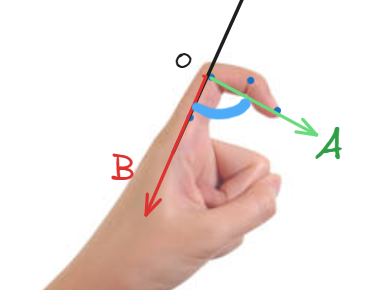
- Multi-Finger Gestures: Using this approach, I implemented recognition for two-finger bent gestures (e.g., index + middle finger), allowing for more complex and expressive controls.
- Relaxed State: To avoid gesture overlap and false positives, I defined a “relaxed” state for fingers, ensuring the system distinguishes between intentional and unintentional gestures.
This system supports:
- Single finger bend (e.g., index bend)
- Double finger bend (e.g., index + middle bend)
Helper functions (example implementation)
Below are short, copy-pasteable Python helpers you can place in gesture_processor.py (or inline in your pipeline) to detect finger bends and deduce single- or multi-finger dynamic gestures. They assume landmarks are lists/arrays of 21 (x,y[,z]) coordinates normalized to the same reference used elsewhere in the pipeline.
import numpy as np

def calculate_angle(a, b, c):
    """Return the angle (in degrees) at point b formed by points a-b-c.

    a, b, c: iterable 2D coordinates (x,y) or arrays.
    """
    a = np.array(a[:2], dtype=np.float32)
    b = np.array(b[:2], dtype=np.float32)
    c = np.array(c[:2], dtype=np.float32)

    ba = a - b
    bc = c - b
    denom = (np.linalg.norm(ba) * np.linalg.norm(bc)) + 1e-8
    cos_angle = np.dot(ba, bc) / denom
    cos_angle = np.clip(cos_angle, -1.0, 1.0)
    angle_rad = np.arccos(cos_angle)
    return float(np.degrees(angle_rad))


def detect_index_finger_bend(landmarks, lower=60.0, upper=130.0):
    """Detect whether the index finger is bent using landmarks indices 5-6-8.

    Returns (is_bent: bool, angle: float).
    Landmark indices follow MediaPipe convention: 5=MP (base), 6=PIP (joint), 8=tip.
    We compute the angle at the PIP joint (landmark 6) using vectors (5->6) and (8->6).
    """
    try:
        a = landmarks[5]
        b = landmarks[6]
        c = landmarks[8]
    except Exception:
        return False, 0.0

    angle = calculate_angle(a, b, c)
    is_bent = (angle >= lower) and (angle <= upper)
    return is_bent, angle


def detect_middle_finger_bend(landmarks, lower=60.0, upper=130.0):
    """Same as index but for middle finger (landmarks 9-10-12)."""
    try:
        a = landmarks[9]
        b = landmarks[10]
        c = landmarks[12]
    except Exception:
        return False, 0.0
    angle = calculate_angle(a, b, c)
    is_bent = (angle >= lower) and (angle <= upper)
    return is_bent, angle


def detect_gesture_type(region, landmarks, bend_thresholds=(60.0, 130.0)):
    """Determine dynamic gesture type and store it in `region.dynamic_gesture`.

    The function checks index and middle finger bends and sets:
      - 'index_only' if only index is bent
      - 'index_middle' if both index and middle are bent
      - 'relaxed' otherwise

    It also stores numeric angles and individual finger states on `region` for debugging.
    """
    idx_bent, idx_angle = detect_index_finger_bend(landmarks, *bend_thresholds)
    mid_bent, mid_angle = detect_middle_finger_bend(landmarks, *bend_thresholds)

    region.finger_states = {
        'index': {'bent': idx_bent, 'angle': idx_angle},
        'middle': {'bent': mid_bent, 'angle': mid_angle}
    }

    if idx_bent and not mid_bent:
        region.dynamic_gesture = 'index_only'
    elif idx_bent and mid_bent:
        region.dynamic_gesture = 'index_middle'
    else:
        region.dynamic_gesture = 'relaxed'

    return region.dynamic_gesture
Usage notes
- Put these helpers in
gesture_processor.pyand calldetect_gesture_type(region, region.landmarks)after landmark postprocessing. - Tune
lower/upperangle thresholds per device / camera angle if needed — the provided defaults (60°–130°) follow your earlier specification. - The
regionobject will receivedynamic_gestureandfinger_statesattributes for downstream handling and debugging.